Recoaro Terme

Province of Vicenza, Veneto, Italy

Recoaro Terme

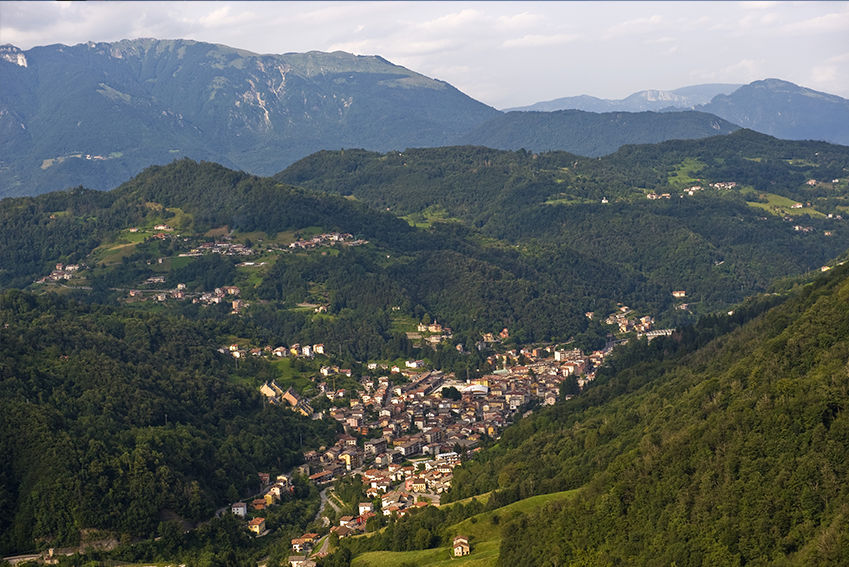
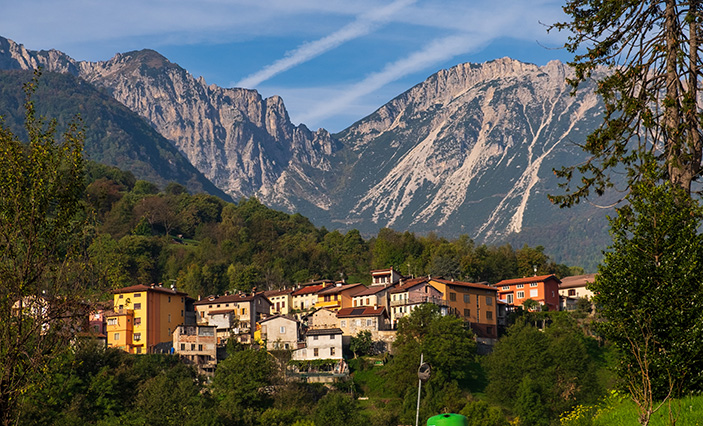
A small alpine spa town tucked into the Piccole Dolomiti of northern Italy — the ancestral cradle of the Asnicar family and home to the celebrated Seven Springs whose mineral waters have been bottled and shipped across the world for more than two centuries.

The Asnicar Family and the Ten Founding Houses

The Asnicar Family and the Ten Founding Houses

Family tradition, preserved in parish records and oral history passed down through the generations, holds that the Asnicar were one of the ten founding families of Recoaro Terme — pioneers who settled the high valley of the Agno river roughly one thousand years ago.

In the centuries following the collapse of Roman administration in the Veneto, the steep alpine valleys of the Piccole Dolomiti were repopulated by small Lombard and Germanic-speaking groups moving south from the Trentino. By the eleventh century, ten extended households had carved out clearings, built water-driven mills, and established the malghe (high-altitude summer pastures) that still define the landscape today. Together they formed the comunella, a cooperative governing body that managed forests, springs, and grazing rights long before Recoaro was granted its own statutes.

The Asnicar name appears in some of the earliest surviving notarial acts from the Diocese of Vicenza, identifying the family as keepers of one of the upper springs and as wool-and-cheese tenants of the Maltraverso lords. Over the next thousand years, branches of the family spread north onto the Altopiano dei Sette Comuni — including Asiago, where the most recent generations of this tree were born — but the trunk of the family is still rooted in Recoaro.

The other founding houses included the Lora, Lorgna, Capitello, Franco, Giuliana, Civillina, Amara, Spilech, and Sengio lines — surnames that survive today as the names of the town's famous mineral springs, a quiet daily reminder of the families who first claimed and protected this valley.
The Seven Springs: Water That Travels the World

The Seven Springs: Water That Travels the World

Recoaro Terme is built on top of an extraordinary geological accident. Rainwater falling on the high slopes of the Piccole Dolomiti seeps slowly through layers of porphyry, limestone, and dolomite over decades — sometimes more than fifty years — before emerging at the valley floor as cold, mineral-rich water. Seven distinct springs surface within a short walk of the town center, each with its own chemistry, name, and devoted following:

  • Fonte Lora — the original spring, "discovered" in 1689 by Count Lelio Piovene, ferrous and slightly sparkling, traditionally taken for anemia and digestion
  • Fonte Lorgna — bicarbonate-alkaline, the gentlest of the springs, prescribed to children and the elderly
  • Fonte Nuova (Capitello) — the most heavily mineralised, drawn from the deepest aquifer
  • Fonte Amara — magnesium-sulphate, intensely bitter, used as a natural purgative
  • Fonte Franco — calcium-rich, recommended for bone health
  • Fonte Giuliana — the lightest table water, the basis of the modern bottled brand
  • Fonte Civillina — sulphurous, used externally in the Terme's thermal baths

In 1895 the first commercial bottling plant opened in the valley, and within a generation Acqua Recoaro had become one of the most recognised mineral waters in Italy. Today the brand — now part of a larger international beverage group — ships water drawn from these same alpine springs to dozens of countries, and Fonte Giuliana water is used as the base for sodas, tonics, and flavoured drinks sold on every continent. The springs that once gave their names to the founding families now carry the name of this valley into kitchens and cafés around the world.

The Royal Summer Palace and a Century of Crowned Visitors

The Royal Summer Palace and a Century of Crowned Visitors

By the middle of the nineteenth century Recoaro's combination of cold mineral water, mountain air, and easy carriage access from Vicenza had made it one of the most fashionable spa resorts in Europe. The Habsburg administration of Lombardy-Venetia built a grand bathing pavilion in 1838, and after Italian unification the town became a regular summer destination for the royal House of Savoy.

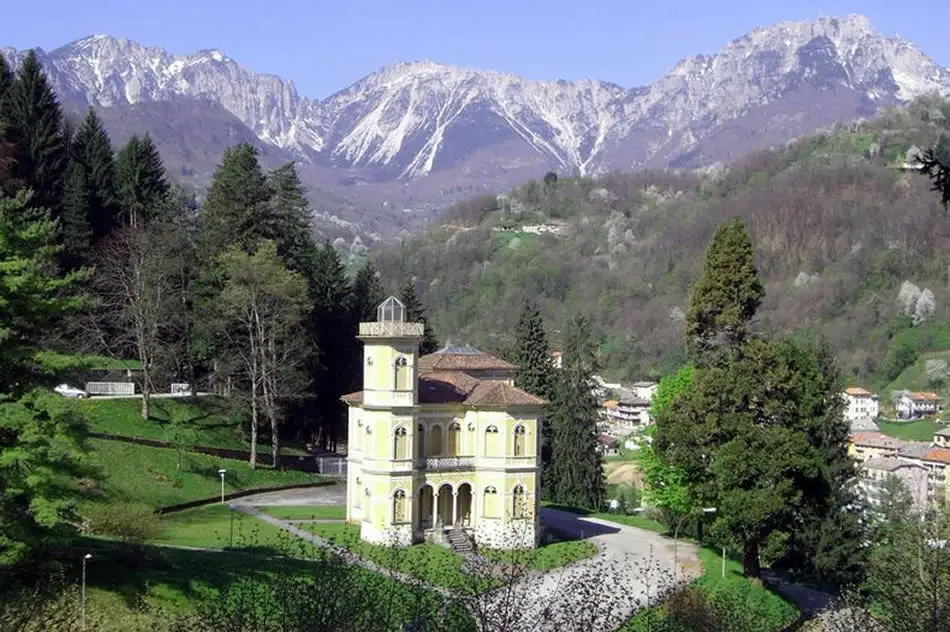
Queen Margherita of Savoy — Italy's first queen and the namesake of the pizza margherita — took the waters at Recoaro repeatedly between the 1880s and the First World War, accompanied by an entourage of ladies-in-waiting, physicians, and a small army of porters. The villa she occupied on the slope above the springs was known locally for decades afterward as the Palazzo della Regina ("the Queen's Palace") and became the model for a generation of grand alpine summer residences.

Recoaro also hosted, at various times, members of the Habsburg imperial family from Vienna, the Wittelsbachs of Bavaria, Tsar Alexander III's sister Grand Duchess Maria Alexandrovna during a tour of northern Italy, the exiled royal family of Saxony, and minor branches of the Hohenzollerns and the House of Liechtenstein. Composers, poets, and prime ministers followed the royals: Giosuè Carducci wrote here, and the young Gabriele D'Annunzio scandalised the spa season of 1893 with a series of public flirtations.

The era of crowned heads ended with the Great War, but the Palazzo della Regina still stands above the valley, its ballroom now restored as part of the Terme's cultural calendar.

April 1945: The End of the War in Italy

April 1945: The End of the War in Italy

From the autumn of 1944 until the spring of 1945, Recoaro Terme served as the forward headquarters of Heeresgruppe C — the German army group commanding all Wehrmacht forces in Italy under Field Marshal Albert Kesselring and, after his transfer, General Heinrich von Vietinghoff. The town's grand hotels and the Palazzo della Regina itself were requisitioned as command offices, telephone exchanges, and officers' quarters. Resistance fighters of the local Brigata Pasubio operated in the hills around the town, and the population lived under constant Allied air observation.

It was in Recoaro, in mid-April 1945, that the final secret negotiations between German plenipotentiaries and Allied intelligence officers (Operation Sunrise) reached their decisive phase. The instrument of surrender for all German forces in Italy — signed at the royal palace of Caserta on 29 April 1945 and taking effect on 2 May — was drafted and authorised here in the valley. Recoaro thus became, almost by accident, the place where the Second World War in Italy was effectively brought to an end, a full week before the surrender at Reims.

Carlo Asnicar, then a twenty-year-old student home from Padua, was among the local young men who watched the German column withdraw down the valley road on the morning of 1 May 1945. His handwritten diary of those weeks, preserved in the family archive, is one of the small primary sources cited in regional histories of the war's end in the Veneto.

Visiting Recoaro Today

Visiting Recoaro Today

Modern Recoaro Terme is a quiet town of roughly six thousand residents. The Terme complex — open to day visitors from May to October — still serves the original seven springs in a restored neoclassical pump room, and the surrounding Piccole Dolomiti offer some of the best hiking and via ferrata routes in the Veneto. The Conca di Smeraldo ("emerald basin") above town and the spectacular Strada delle 52 Gallerie military road of the First World War are within a short drive.

For descendants of the founding families, the parish church of Santa Maria Assunta holds baptismal and marriage registers going back to 1567, and the municipal archive maintains property records that in some lines reach back to the fourteenth century. Researchers tracing the Asnicar line — or any of the other nine founding houses — are warmly received by the *Ufficio Anagrafe* on weekday mornings.

Recoaro 1000: Skiing the Piccole Dolomiti

Recoaro 1000: Skiing the Piccole Dolomiti

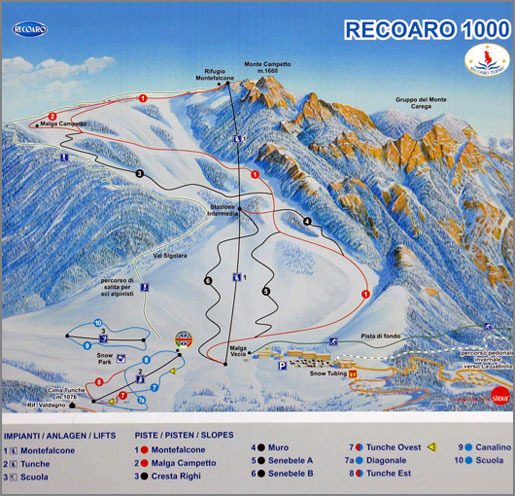
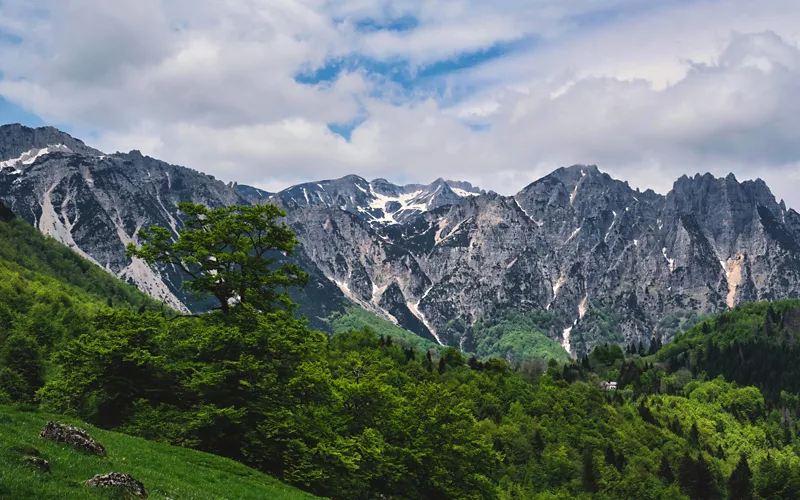
Above the town, the modern resort of Recoaro 1000 opens the upper valley to skiers and walkers. Lifts climb from Cima Tunche (1,076 m) up toward Rifugio Montefalcone and the *Gruppo del Monte Carega* — the southernmost spur of the Piccole Dolomiti.

The ski area links ten named runs across the south face of Monte Campetto, from gentle blue pistes like *Scuola* and *Senebele* to the steep red descents of *Tunche Ovest* and *Canalino*. A dedicated *snow park* and a *snow tubing* area near Malga Vecla make the resort a family destination in winter, while the same slopes turn into a network of high-altitude hiking and mountain-bike trails in summer.

For descendants of the Asnicar households, the upper valley remains the same alpine pasture their ancestors worked: the *malghe* (Campetto, Vecla, Sigolara) named on the modern piste map are the very names that appear in nineteenth-century parish records of the family.