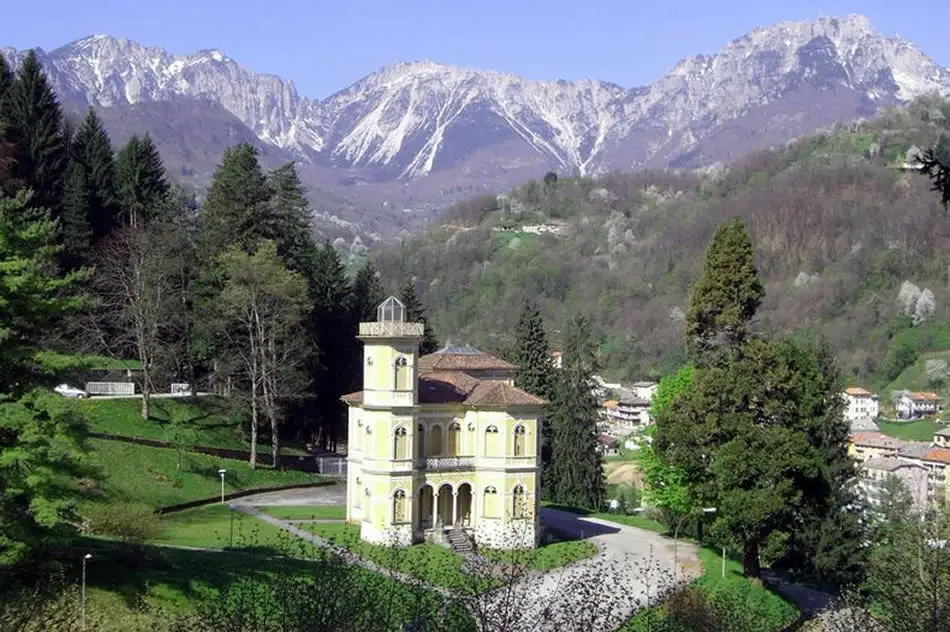
Religious discretion in the Agno Valley
The history of religious communities in Recoaro is inseparable from the town's sudden transformation, after the discovery of the Lelia spring in 1689, from a rugged German-Cimbrian mountain settlement into a playground for the European elite. The following century-and-a-half of growth meant that the local Church was no longer simply ministering to shepherds and bath attendants — it was hosting the personal physicians, confessors and chaperones of the most powerful houses in Europe.
A timeline of the institutional shift
- 1689 — Healing springs discovered. Recoaro changes overnight from a mountain village into an elite resort, and the diocese of Vicenza begins assigning specialist sisterhoods to the new clientele.
- 1800s — Habsburg and Savoy eras. Grand villas — Villa Margherita (the Palazzo della Regina), Villa Tonello and others — are built or expanded. The Sisters of Charity and the Dorotee become permanent fixtures inside their walls.
- The Nuns' Institutional Role. The sisterhoods act as the trusted layer of privacy for wealthy guests, managing logistics, convalescence, and the fostering of unacknowledged children.
The institutional "omertà" — a code of silence
Under the Habsburg administration of Lombardy-Venetia (pre-1866) and then the Kingdom of Italy, the Catholic Church in the Veneto operated almost as a shadow state. When elite families stayed at remote estates like the Palazzo della Regina — historically also known as Villa Margherita or Villa Tonello — the religious women assigned to assist them were bound by a strict institutional culture of discretion. If a lady-in-waiting or a visiting royal required a discreet place to deliver an unacknowledged child, the convent network provided a closed loop in three layers:
- The convent as a buffer. The nuns provided sanctuary within the villa grounds themselves, well away from the public gaze of the town's thermal pavilion. Births and confinements took place inside a private wing of the palace staffed exclusively by sisters.
- The ledger as legal record. While state birth certificates were suppressed or never issued, in order to protect dynastic lineages, the nuns kept their own private domestic journals and baptismal rolls. These tracked the financial stipends paid by anonymous noble benefactors for each child's upkeep — and effectively became the only surviving legal trace of the child's existence.
- Placement with local families. Once the birth was complete and the royal party returned to court, the Dorotee and Compassionist networks handled the placement of the child with a local agrarian family in one of the surrounding hamlets, supported by the anonymous noble stipend routed through the convent's almoner.
Why this system was almost unbreakable
Three forces combined to make Recoaro's convent network uniquely watertight:
- Vows of obedience and silence. Sisters who would otherwise have nothing in common with the European nobility were institutionally incapable of speaking about what they saw, on pain of removal from the order.
- Geographical isolation. Recoaro's hairpin road from Valdagno made casual visits and gossip from Vicenza practically impossible during winter.
- Plausible medical cover. Every long-term female guest had an obvious, unimpeachable reason to be in Recoaro — she was "taking the cure" for anemia, nervous exhaustion or respiratory weakness.
The post-war fate of the sisterhoods
The era of the crowned heads and the elite spa culture shattered with the onset of the First World War. The convent's day-to-day function evaporated almost overnight, replaced by the much grimmer business of caring for the wounded of the Pasubio and Piccole Dolomiti front lines.
During the Second World War, Recoaro's isolation was weaponised in an entirely different way. The German High Command — Armeeoberkommando 10 — requisitioned the thermal complex and turned it into a heavily fortified bunker system commanding the approaches to the Veneto. Following the Allied bombings of 1945 and the subsequent collapse of the classic "thermal cure" lifestyle in the mid-20th century, many of the small local religious outposts faded away. The Dorotee and Sisters of Charity withdrew to their mother houses in Vicenza and Lombardy, and the convent buildings inside the great villas were repurposed or simply locked.
It is this twilight withdrawal — papers boxed up and shipped out of Recoaro in the late 1940s and 1950s — that explains how the convent journal could have lain undisturbed for three quarters of a century in a Vicentine archive. And it is exactly why what it contains is now so explosive.